Feature
Full circle: What a year of change means for Rwanda's inclusive insurance moment
From winning the Luxembourg Award for Inclusive Finance to hosting the sector’s flagship conference, Rwanda’s inclusive insurance journey has come full circle. Eleven months after Radiant Yacu was recognised on the global stage in Luxembourg, Kigali is preparing to welcome ICII 2026 and the international inclusive insurance community. This article looks at what has changed over the past year – from Radiant Yacu’s efforts to expand digital distribution and reach more customers, to the lasting impact of ICII 2025 in Quito, where inclusive insurance gained a stronger place in Ecuador’s financial inclusion agenda. As Rwanda takes centre stage, explore what its progress, ambitions and challenges reveal about the future of inclusive insurance – and why the real test begins after the conference ends.
Meet our new members
La Boliviana Ciacruz Seguros (LBC Seguros)
With 80 years of experience in Bolivia’s insurance industry, LBC Seguros provides insurance solutions tailored to the needs of individuals and businesses, serving more than 2.6 million individual and corporate clients across the country. Its portfolio includes personal insurance such as auto, home, life and accident cover, as well as solutions for professionals, SMEs and larger businesses, including operational risk, civil liability and comprehensive asset protection. LBC Seguros also offers mass insurance solutions through partnerships, combining its experience with a focus on innovation, customer service and inclusion.
MiN, Members & Partners: Upcoming Events
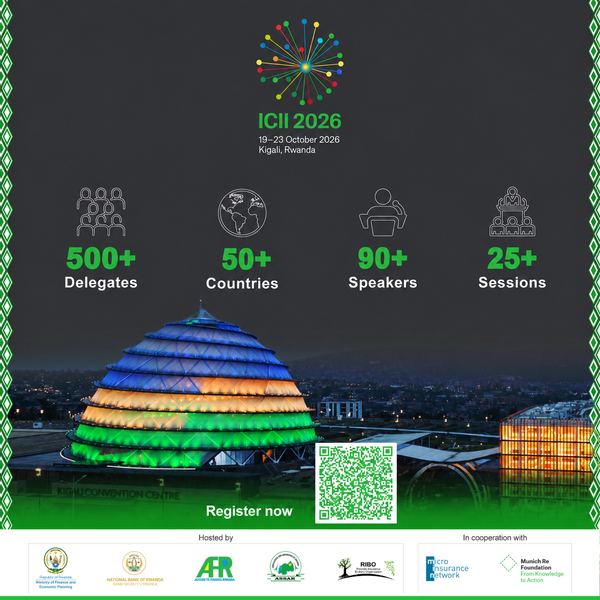
- International Conference on Inclusive Insurance (ICII) 2026 | 19-23 October 2026 | Kigali, Rwanda – REGISTER NOW /// View sponsorship opportunities
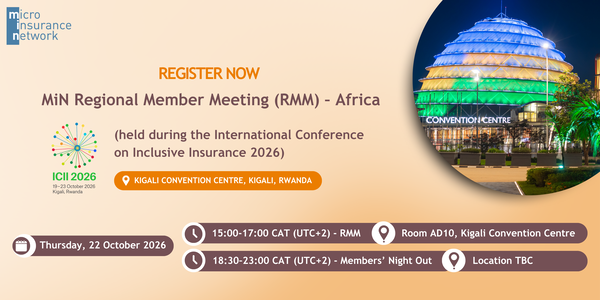
- Regional Member Meeting – Africa (alongside the ICII 2026) (organised by Microinsurance Network, sponsored by Radiant Yacu) | 22 October 2026 from 14:00-16:00 CAT, followed by Members’ Night Out | Register here (members only)
- Off the Record - Kigali 2026: A Networking Evening Discussing Failure and the Real Challenges of Scaling Inclusive Insurance with Rishi Raithatha and Jack Farren | 19 October 2026 from 6:30pm CAT onwards | Register here
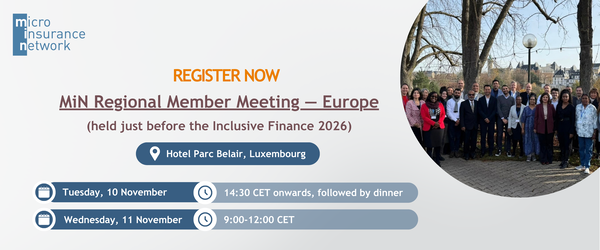
- Regional Member Meeting – Europe (just before the Inclusive Finance 2026) (organised by Microinsurance Network) | 10-11 November 2026 | Register here (members only)
- Medellín Climate Week Biodiversity 2026 (organizado por UNEP FI, Naciones Unidas Colombia) | del 28 de septiembre al 1 de octubre | Regístrese aquí
- The Global Shield Webinar Series | Webinar 2. From Risk to Response: Designing CDRFI Solutions and Instruments | 29 September 2026 from 11:00–12:30 CEST | English with live captions & French interpretation | Register here
- Luxembourg Inclusive & Impact Finance Ecosystem – Launch Webinar (organised by InFiNe, Luxembourg Sustainable Finance Initiative (LSFI) & the Impact Investing Advisory Board) | 1 October 2026 | Register here
- Resilient and Equitable Futures: Protecting Communities and Nature Through Insurance – a conversation with Anne Kamau (AB Entheos) and Dave Jones (former California Insurance Commissioner) (organised by Salzburg Global) | 1 October 2026, from 17:00-17:30 CEST | Learn more
- Microinsurance Network at the Financial Inclusion Week (FIW) 2026 | Session “Measuring Protection, Unlocking Resilience - Insights on measuring the impact of inclusive insurance” (by AXA, J-Pal, 60 Decibels) | 5 October 2026 from 16:30-17:15 CEST | Register here
- Forum des marchés & Symposium sur l'Assurance Santé | Lomé, Togo (organisé par FANAF) | Du 02 au 05 novembre 2026 | Inscription
- Inclusive Finance 2026 (IF26) (organised by e-MFP, Luxembourg Ministry of Foreign and European Affairs, Defence, Development Cooperation and Foreign Trade (MFA), InFiNe) | 11-13 November 2026 | Neimënster Abbey, Luxembourg and Online | Early bird registration now open
Recap past events:
- Regulatory Sandbox Realities from Across Africa (organised by FSD Africa) | Watch the recording
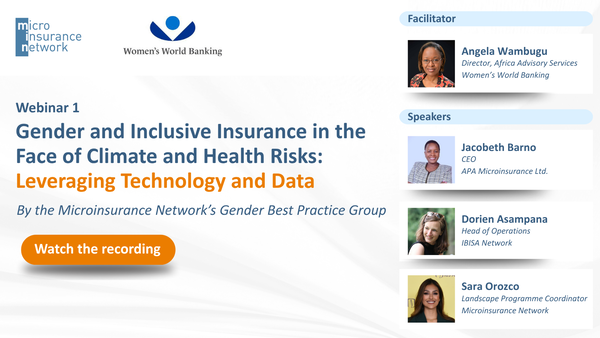
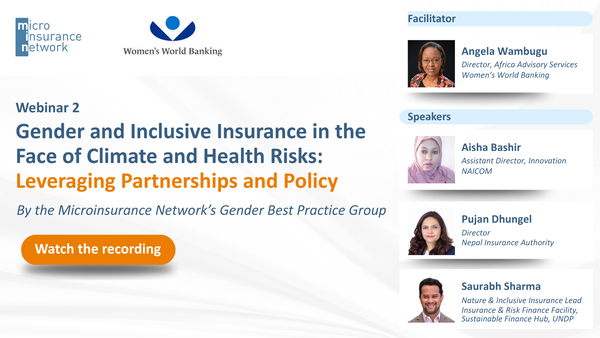
- MiN’s Gender & Inclusive Insurance Best Practice Group webinar series - watch the recordings | Leveraging Technology and Data (7 September 2026) /// Leveraging Partnerships and Policy (14 September 2026)
MiN, Members & Partners: News, Blogs & Resources
- Microinsurance Network & the ILO’s Impact Insurance Facility | Technical note – Improving distribution strategies in inclusive insurance | Available in English, French & Spanish
- AB Entheos at ICII 2026: Human-wildlife conflict and the case for insurance for nature
- Global positioning: the ICII making insurance more accessible (by Lisa Morgan, ILO)
- 3IF Ventures invests in African insurtech Turaco
- Busara | Introducing GRACE: The behavioral & human-centered Persona Toolkit
- Business Partnership Facility Luxembourg (BPF) | Call for proposals: Up to EUR 300,000 in co-financing for Luxembourgish/EU companies for innovative, high-impact projects bringing together European companies and partners in developing countries | Apply by 31 October 2026 /// Information webinars: 29 September, 3:00-4:30pm CEST (English) | 30 September, 11:00-12:30am CEST (Français)
- DHAN Foundation | 20th International Course: Advanced Reflective Education and Training (ART) on Mutual Insurance | 13-16 October 2026 | Learn more & register by 30 September 2026
- e-MFP | Gender Lens Investing Resource Portal – New resources available
- e-MFP, Luxembourg Ministry of Foreign and European Affairs, Defence, Development Cooperation and Foreign Trade (MFA), InFiNe | Meet the finalists of the Luxembourg Award for Inclusive Finance 2026 (LAIF26)
- FANAF sets a new pan-African ambition for inclusive insurance (Français)
- Global Shield Solutions Platform (GSSP) & African Risk Capacity Ltd. | Scholarships available for up to two years of full-time study in the fields of actuarial science, insurance, agricultural statistics | Apply by 7 October 2026 (disponible en français)
- Grameen Crédit Agricole Foundation | Integrated 2025 report
- Munich Re Foundation | Building Capacity for Inclusive Insurance – Learnings from the Impact Insurance Academy 2026
- Insurance Development Forum (IDF) and AFD Group | Integrated Disaster Risk Management Alliance (IDRIMA) Paper “From Exposure to Protection: The Case for Parametric Insurance Revenue Cover for Hydro-Dependent Utilities in Eastern and Southern Africa”
- Insurance Development Forum & ZEP-RE | From Protection Gap to Insurability: Building Africa’s Next Generation of Resilience (by Ekhosuehi Iyahen & Hope Murera)
- UNDP | Reimagining Insurance for Uganda’s Farmers and Small Businesses
- Securities and Exchange Commission of Pakistan (SECP) Wins Global Award for Women’s Inclusive Insurance
Jobs, Internships & RFPs
- Access to Finance Rwanda (AFR) | Demonstration Centre Coordinator | Kigali, Rwanda | Apply by 25 September 2026
- Access to Finance Rwanda (AFR) | Monitoring, Evaluation and Learning Lead | Kigali, Rwanda | Apply by 25 September 2026
- Busara | Senior Associate – Governance | Nairobi, Kenya | Apply here
Elsewehere in the sector…
- AXIAN, African Development Bank Launch Digital Finance Programme to Support 34,000 Women-led Businesses in Africa
- Kylian Mbappé-backed health start-up expands to west Africa
- Nigeria’s National Insurance Commission launches insurance sector strengthening programme to deepen coverage
- Singapore insurer details climate transition efforts in sustainability report
- Swiss Capacity Building Facility | Annual Report 2025
Prefer reading on the web or want to share? View the full newsletter here.