Why the horse isn’t drinking: Behavioural diagnostics for inclusive insurance teams
Many inclusive insurance practitioners will offer similar and familiar reasons for low uptake: “premiums are too high”, “products are too complex” or “people just don’t understand insurance”. Yet, emerging discussions show that for many inclusive insurance schemes, affordability is no longer the main constraint. There are other reasons why people may not buy or use insurance cover. More often, the reason is likely to be customer behaviour.
“We’re good at taking the horse to water, less so at understanding why it isn’t drinking.”
There is a good reason for this. Insurance is intangible: customers – typically with a limited safety net – are asked to pay today for a promise that may or may not materialise in the future. In markets where financial exclusion is high and where trust in financial institutions is low, asking people to purchase insurance can be a significant request. This is especially tricky where there might have been mixed experiences. A disputed claim, lack of payout, poor experiences by peers and difficult claims processes can affect how people perceive insurance.
The idea to help microinsurance providers better understand customer behaviour around insurance emerged out of a community of practice (CoP) run by Busara and the Microinsurance Network (MiN), between September 2025 and February 2026. MiN members in the CoP observed that when faced with weak performance, insurers and their partners often jump to solutions. This includes redesigning the product, changing the channel, tweaking incentives, or adding a subsidy. While understandable, such reactions are more likely to be based on assumptions, rather than diagnosing customer behaviour.
How inclusive insurance providers can transition from problems to behaviours
In collaboration with the MiN, Busara, a research house that specialises in behavioural science, recently published “The Behavioural Diagnostics Toolkit for Inclusive Insurance.” The toolkit is designed for inclusive insurance designers and their partners to change their approach from using assumptions to assessing the actual problems.
The toolkit starts with a simple idea: before choosing solutions, inclusive insurance providers should have clarity about which behaviours they want to change, and why those behaviours are not happening today. Users are discouraged from relying on vague problem statements, such as “low uptake” or “poor engagement”. Instead, users have to define a specific target behaviour. For example, “first‑time policyholders renew for a second season”, “eligible clients submit claims for a covered event”, or “agents introduce the insurance in most of their customer conversations”.
Once a desired behaviour has been established, the toolkit introduces the COM‑B framework: capability, opportunity and motivation, which leads to the new behaviour (Figure 1). This can be applied across the entire value chain, and offers a structured way to understand what is driving or blocking a behaviour in practice. It can be used to diagnose client behaviours, as well as the behaviours of agents, loan officers and aggregator staff. In some cases, the analysis may show that operational issues may affect behaviour. Slow claims processing, poor communication or misaligned incentives can undermine trust and motivation, and feed directly into behaviour.
Figure 1: Detailing the COM-B framework
| Capability | Do customers and agents know what to do? Do they understand the product, the triggers and the process? |
| Opportunity | Are there practical and social conditions that allow them to act? Can customers access the channel easily? Are there norms or power dynamics that discourage claims? |
| Motivation: | Do people see value in the product? Do they trust that it will pay? Does the cover fit how they think about risk and loss? |
Source: MiN & Busara (2026). Behavioural diagnostics toolkit for inclusive insurance
The toolkit is less of an academic manual and more of a practical guide
Within the inclusive insurance space, there is a growing interest in behavioural science – despite it being seen as a specialised field. The MiN–Busara toolkit is designed to overcome this concern. It can be used by product, innovation and distribution teams, without requiring a background in behavioural economics. It includes a step‑by‑step workflow to follow in sequence. Users walk through defining the problem, applying the COM‑B framework, mapping customer and agent journeys, designing interventions, and planning for tests and scale‑up.
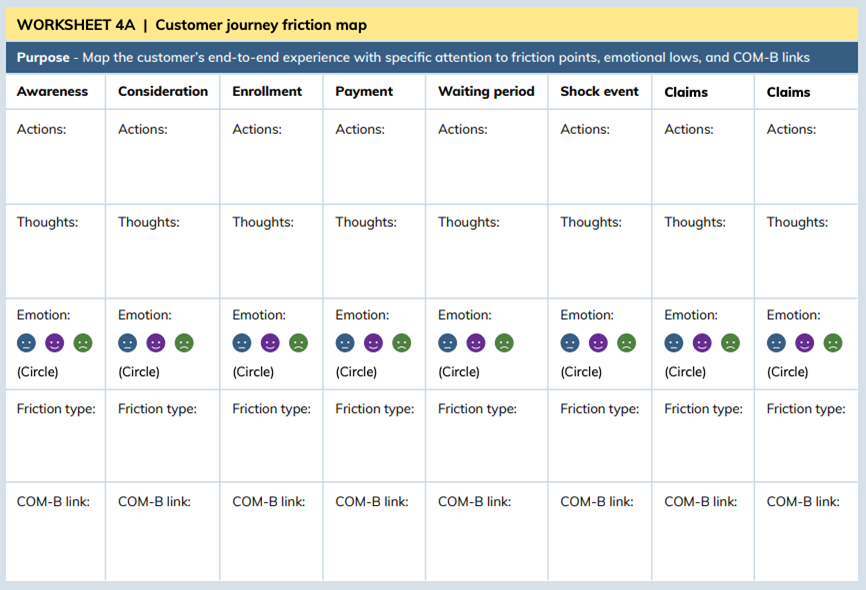
Each step includes worksheets (Figure 2), prompts and a fictional insurance case study that illustrates how the proposed tools could be used in practice. This supports Busara’s desired intention to produce a “one step at a time” guide. Inclusive insurance providers are not expected to fix every issue at once. Instead, the toolkit encourages them to focus on a narrow set of behaviours and a handful of points to consider further.
Figure 2: A sample worksheet from the toolkit
Source: MiN & Busara (2026). Behavioural diagnostics toolkit for inclusive insurance
This was an important choice. Inclusive insurance schemes can be affected by several problems: low registrations, low renewals, low claims usage and low cross-sell opportunities, among others. Trying to resolve all of these at once can spread resources thin and make it challenging to figure out what might work and what doesn’t work. The toolkit suggests that once a particular behavioural bottleneck has been diagnosed, users should prioritise the most promising area and concentrate their efforts there.
The toolkit is specifically designed to be used inside organisations
The Behavioural Diagnostics Toolkit is more than just a set of methods: it also offers suggestions on ways of working. Busara tested this among a set of organisations, which found that the toolkit works best when used by cross-functional teams rather than by individuals working alone. A typical product development process might involve product managers, distribution leads, operational staff and, where relevant, partner representatives. By using the toolkit, any group can use the worksheets, combined with their knowledge of customers, systems and constraints.
In doing so, the toolkit can become a common platform and offer shared language for disparate organisations to understand why a product might be seeing low uptake. It can be used to identify where assumptions held by different organisations are either aligned or differ. This is an important outcome to aim for. Successful use should not be limited to higher uptake or more claims; it can also mean a clearer understanding of which behaviours matter the most to partners, what might be blocking changes, and which interventions could be worth scaling.
Inclusive insurance stands to benefit from greater use of behavioural thinking
The launch of the toolkit is part of a broader effort by the MiN, as well as Busara, to build and establish the practice of using behavioural thinking across the inclusive insurance ecosystem. While the initial CoP focused on diagnostics, the next may look at communication strategies. This is important, as inclusive insurance providers recognise that how products are explained, framed and discussed is central to customer behaviour.
Box 1: How lessons from ACRE Africa contributed to the toolkit Busara had previously worked with ACRE Africa in 2015, an agricultural insurance technical service provider, to learn why some insurance offers were not resonating with smallholder farmers. Farmers that bought maize seeds would receive a card in the bag with information on the insurance product and how to sign up. This was the only touchpoint ACRE Africa had with the customer. Busara tested a range of experimental designs and found that the card needed to be reframed. Making it more like a scratch card was likely to trigger a response for the farmer to engage, rather than dispose of the card. A number of versions of the card were tested among farmer groups. The cards with personalised messages, relatable visual cues and recognisable images had a positive impact on registration. |
In terms of practical application, Busara has been working with a range of organisations to build capacity in behavioural science and human-centred design. An ongoing collaboration with FSD Uganda has been exploring how behavioural approaches can strengthen insurance capabilities. There is growing interest among regulators and other industry stakeholders to embed behavioural insights into insurance markets. The toolkit can catalyse systemic change by supporting regulators, policymakers and other market actors in improving consumer protection, strengthening disclosure and complaints, and designing more customer-centric products.
Within these organisations, CEOs and other senior leaders are the prime targets. Behavioural tools are likely to be more effective if their utility is better understood at the decision-making level. Senior staff are responsible for allowing experimentation, allocating resources and accepting test results – even if these are likely to fail. Without senior leadership support, behavioural projects can risk becoming isolated pilots.
To learn more about the toolkit, please watch the launch webinar. The toolkit can be accessed here.