The elephant in the room: insurance, climate resilience and opportunities for Latin America and the Caribbean
By Carlos Boelsterli, MiCRO & Nicolás Morales, Microinsurance Network
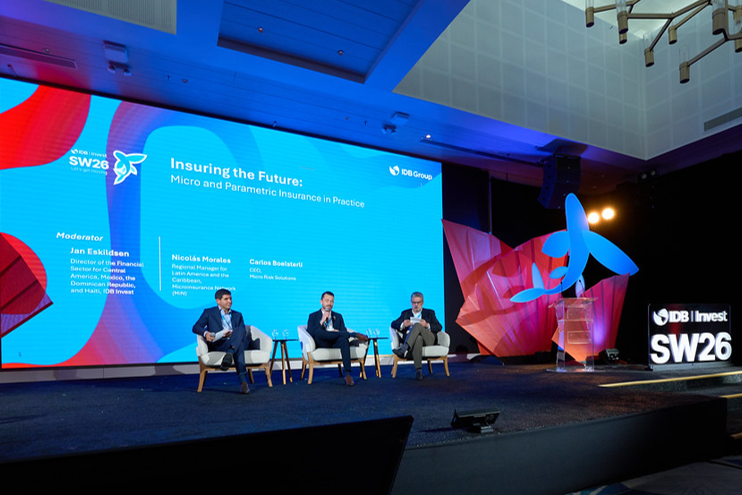
Can we afford to let insurance become unavailable or remain inaccessible to those who need it most? This uncomfortable but urgent question took centre stage at the “Sustainability Week 2026” del BID Invest (SW26), held this year in Barbados, where more than 800 participants from 46 countries discussed the major climate and financial challenges facing the future of Latin America and the Caribbean.
Against this backdrop, MiCRO — a specialist in parametric microinsurance that already protects more than 690,000 people across six Latin American countries — and the Microinsurance Network joined the programme as organisations with a shared vision: to strengthen the resilience of vulnerable populations in the face of climate risks through accessible and sustainable financial protection solutions.
The elephant in the room: Access to insurance

Mia Mottley
Prime Minister
Barbados
For small island states, the situation is particularly critical. Their size, high exposure to natural hazards and the limited scale of their markets mean that traditional insurance and reinsurance solutions fall short. As the Prime Minister pointed out, “these countries often face structural challenges that are not fully understood by the rest of the world, despite being on the front line of the climate crisis.”
An opportunity to transform climate risk management
Latin America and the Caribbean bring together two realities that should not coexist: high exposure to climate risks and one of the widest gaps in insurance protection in the world. Millions of families, smallholder producers and micro-enterprises continue to face extreme weather events (hurricanes, floods, droughts, amongst others) without any financial protection. Governments, for their part, are seeking new tools to strengthen the resilience of their economies without compromising their fiscal sustainability. Far from being merely a challenge, this reality presents an unprecedented opportunity to innovate in the way we manage climate risks.
One of the most concrete ideas to emerge during the week was regional risk pooling: if the small island states of the Caribbean, the Pacific and the Indian Ocean could pool and manage their risks collectively, they would unlock access to insurance coverage that is simply out of reach today. Regional collaboration, in this case, is not an abstract ideal; it is a technical prerequisite for solutions to work.
From conversation to action
Mottley’s challenge found a direct response in the panel discussion on parametric insurance and climate resilience, in which Carlos Boelsterli, CEO of MiCRO, and Nicolás Morales, Regional Manager for LATAC at the Microinsurance Network, took part alongside Jan Petter Eskildsen, Director of IDB Invest. The panel began with an observation that seems obvious but is rarely stated explicitly: climate change is almost always discussed in terms of infrastructure, energy or finance, but there is an equally important dimension that is overlooked: the ability of people and organisations to recover quickly when a disaster strikes. This is where parametric insurance comes in as a tool – not as a traditional financial product, but as a mechanism for accelerated recovery.
Unlike conventional insurance, which requires damage to be assessed on a case-by-case basis before a payout is made, parametric insurance is triggered automatically when a weather event exceeds a predefined threshold: the wind speed of a hurricane, flood-triggering rainfall levels, or the temperature during a drought. This eliminates weeks or months of waiting at a time when families and businesses need liquidity the most.

However, one of the most significant conclusions from the discussion was that the challenge is no longer simply about designing good products. In many cases, the technology, data and technical capacity to build these solutions already exist. The real challenge is scaling them up.
During the panel discussion, it was emphasised that achieving this scale requires moving beyond traditional distribution channels and beginning to build ecosystems around climate risk management. Experience gained in various markets shows that financial channels are essential for facilitating premium collection and payments, but they are not always sufficient to reach the most vulnerable populations or to generate the levels of trust, education and support that these solutions require.
This observation is not merely theoretical. During the discussion, one of the key lessons learnt by MiCRO in Latin America was shared: innovation depends not only on product design, but also on the ability to build partnerships that enable these solutions to reach those who need them most. In Colombia, for example, the parametric insurance schemes developed by MiCRO have succeeded in protecting more than 120,000 low-income people, demonstrating that the combination of technology, financial protection and strategic partnerships can make insurance models viable for traditionally excluded populations.
As a result, parametric insurance is driving a new approach to collaboration in which insurers, financial institutions, governments, cooperatives, agricultural organisations, technology platforms and other stakeholders work in a coordinated manner, based on a recognition of the benefit to them of ensuring that ‘the last in the chain’ can recover more quickly from disasters caused by natural phenomena. Rather than simply distributing insurance, the aim is to build ecosystems of resilience capable of bringing financial protection to the most vulnerable communities and strengthening their ability to recover from increasingly frequent and intense climate events.
A strategic opportunity for the financial and insurance sectors
Climate risk is no longer a future threat; it is already affecting the stability of economies, the resilience of households and businesses, and the performance of credit and investment portfolios across the region. For financial institutions, the challenge is no longer simply to react when a disaster strikes: it is to understand the climate exposure of their own portfolios and manage it before it materialises as a loss.
Here, parametric insurance offers something that goes beyond protecting vulnerable customers. It can strengthen the resilience of the financial portfolios themselves, reducing the vulnerability of climate-exposed productive sectors and accelerating recovery following a crisis. With sufficient accumulated evidence, this could also pave the way for differentiated financing schemes for clients with better climate risk management: an institution that knows its agricultural portfolio is covered against droughts is not in the same risk position as one that does not have that certainty. Ultimately, the logic is simple: if uninsurable investments are also ‘uninvestable’, then empowering people to manage their risks is not just a matter of financial protection — it is a prerequisite for development.
The result is a framework in which incentives are aligned: individuals and businesses recover more quickly, financial institutions reduce their exposure, and local economies gain systemic resilience.
Looking ahead, “The white elephant in the room can no longer be ignored”
The insurability crisis is not a problem for the future; it is already happening, and Latin America and the Caribbean are at the centre of it. But what became clear in Barbados is that there are also concrete solutions: regional risk pooling, parametric insurance, and distribution ecosystems that reach places traditional channels do not.
The time for diagnosing the problem is over. It is time to build. For the insurance industry, financial institutions, governments and development agencies, the question is no longer whether to act, but how to do so at the speed the crisis demands.
Because resilience cannot be improvised after a disaster. It is built in advance. And perhaps the most important question Barbados left us with is this: which will come first: scaling up financial protection solutions, or the climate crisis rendering insurance out of reach for millions?