How Luxembourg is driving sustainable development: The Business Partnership Facility
In 2024, Ibisa – a Microinsurance Network (MiN) member – partnered with the Association for People’s Development Stream (APDS) for a new initiative in Bangladesh. APDS is the microfinance entity of Friendship, a non-governmental organisation that serves rural communities. Together, they launched a solution that combines climate insurance and microcredit. Ibisa’s parametric insurance is now being distributed via APDS loans. The aims are to protect farmers as they invest in their activities and derisk the microfinance institutions that support farmers.
This venture is an example of how the Business Partnership Facility (BPF) incentivises the private sector to work on sustainable development issues. The BPF is a co‑financing mechanism designed to enable innovative, high-impact business partnerships. In this instance, the BPF supported a partnership to strengthen farmers’ climate resilience. For IBISA, it played a key role in sharing essential early-stage risk financing that is difficult to fund commercially.
What is the Business Partnership Facility?
The BPF is an initiative launched by Luxembourg’s Directorate for Development Cooperation of the Ministry of Foreign and European Affairs, Defence, Development Cooperation and Foreign Trade and implemented by LuxDev, the Luxembourg Development Cooperation Agency. It was set up to encourage companies based in Luxembourg and the wider European Union (EU) to partner with public or private local actors in developing countries eligible for overseas development assistance (ODA). Together, these companies can then pursue sustainable business opportunities.
The Business Partnership Facility is designed to support impactful partnerships led by the private sector. By helping de-risk innovative ideas, it enables companies to unlock new markets and deliver tangible impact for vulnerable communities.” Angeline Rousseau Business Partnership Facility Officer, LuxDev |
The BPF offers co-funding of up to €300,000 for projects that combine business growth with measurable development impact and alignment with the UN Sustainable Development Goals (SDGs). BPF calls for proposals are launched twice a year. Successful applicants receive grant co‑financing, so long as they mobilise their own resources too.
Applications should comprise at least a European lead company and a partner organisation in a developing country
Each application should comprise a lead partner and at least one local player in the target country. The lead partner is expected to be a commercial or co-operative private sector enterprise from the EU. Lead organisations must meet specific eligibility criteria (Figure 1).
Figure 1: Eligibility criteria for the lead partner
The lead partner should:
|
Source: LuxDev
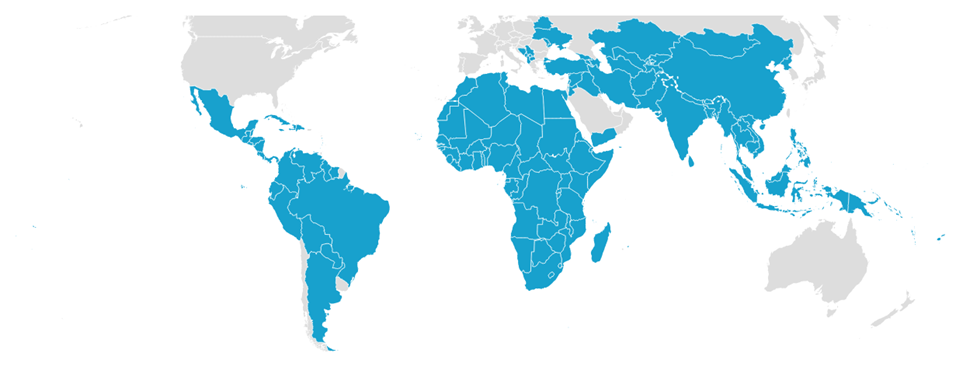
The local partner should be based in a developing country eligible for ODA (Figure 2). This partner can be a company, public entity, non-governmental organisation, university or research centre.
Figure 2: Countries eligible for the BPF
Source: LuxDev
The application and selection process is structured over two main stages that last around ten months (Figure 3). The 2026 window shows a typical timeline: calls for proposals are open until early May; pre-selection will take place in May–June; detailed proposals are due in July–September; selection will be finalised in October–November; and contracting will start in early 2027.
Figure 3: The BPF application stages
| Stage | Deadline | What happens after? |
1. Call for proposals Applicants submit an online concept note with a short project description, information on all partners, the basic business idea, expected impact and SDG contribution.
| 8 May 2026 | The Facility checks eligibility (type of lead company, partnership structure, country, minimum size) and carries out a preliminary due diligence and assessment based on selection criteria (innovation, development impact, feasibility, financial robustness, additionality).
Only pre-selected candidates are invited to proceed to the detailed proposal stage. |
2. Detailed proposal and final selection Pre-selected applicants submit a comprehensive proposal including detailed project description, budget, business case, full business plan and a results framework aligned with the SDGs. | September 2026 (for detailed proposals) | Proposals are assessed by a selection committee and, if approved, move to contracting with LuxDev before implementation.
|
Project begins Successful applicants are required to sign the cofinancing agreement | January 2027 | Monitoring and evaluation of the project begins, and continues for the duration of the project (generally 2 years). |
Source: LuxDev
Joining the BPF presents financial, operational and visibility-related benefits
The BPF offers obvious financial and risk‑sharing benefits for organisations involved. Grant co‑funding of up to €300,000 can reduce the financial burden and risk to be taken for companies investing in challenging or unknown developing‑country markets. This model is designed to encourage companies to crowd in capital and be directly invested in their progress, while using public funds to trial and scale meaningful concepts.
| MiN members based in the European Union, or with partners in the EU, who are keen to launch or grow solutions in developing markets are strongly encouraged to apply for the 15th BPF here by 8 May 2026. |
The Facility is designed to support EU companies as they enter new markets and look to grow their business there. It does so through a structured partnership framework: consortia should include local partners and, where relevant, civil‑society or public institutions. Firms are encouraged to embed their operations in local ecosystems, increasing acceptance and long‑term sustainability. In addition, the selection process exposes projects to external scrutiny by experts – this has the potential of strengthening companies’ business models, impact logic and risk management.
By supporting projects with a clear development impact, the BPF can help companies demonstrate the viability of inclusive and sustainable business models, strengthening their overall sustainability approach. In addition, the Facility offers significant visibility potential: these projects are promoted by the Luxembourg government and LuxDev, opening up additional visibility for companies among impact‑investment networks.
“The BPF allows us to really invest in working with local partners. And that’s essential, because our model depends on building and strengthening those relationships on the ground.” Maria Mateo Iborra CEO, Ibisa |
The BPF has supported several projects, including two in inclusive insurance
Since 2016, the BPF has supported at least 54 partnership projects between European companies and local partners in developing countries. Projects have emerged from a range of sectors. In addition to climate insurance, these include e‑mobility, agri‑value chains, agri-food processing, health and renewable energy, among others. All these combine business expansions with SDG‑aligned impact, such as jobs or income generation and environmental benefits.
Watch this short video for an overview of the impact achieved by the BPF in the last 10 years:
Ibisa’s involvement with the BPF marks the first time a MiN member has been part of the Facility. After an initial BPF project in Niger in 2019, Bangladesh is the second BPF project Ibisa is involved in. Six months after its launch, nearly 4,800 farmers have been reached through awareness activities. Around 2,300 have adopted the insurance product, exceeding initial targets. Over its two-year duration, the project aims to insure 10,000 farmers and raise awareness among 20,000 people. Beyond this, Ibisa aims to replicate such climate-risk products in other markets.
OKO – an agri-insurtech – has also successfully benefited from the BPF. In 2025, it partnered with Weather Impact to provide smallholder maize farmers in Mali with crop insurance, weather forecasts and alerts. All of these are delivered by mobile, either as a bundle or individual services. Early results saw a clear preference for the bundle: out of 1,537 total paying customers identified, 1,329 opted for the bundle. This highlights how integrated services can better equip and empower underserved farmers to manage risks and improve their resilience.
These examples highlight the BPF’s commitment to achieving impact by combining technological innovation, strong local anchoring and public support. The BPF has enabled partners to test and refine their integrated product. In doing so, it has helped to bridge the gap between innovation and scale. This demonstrates how blended partnerships can strengthen climate resilience while reinforcing financial inclusion.
Find out more about the BPF and apply for the 2026 cohort here.