Big risks, micro protection: An unfinished story from the 2026 Landscape of Microinsurance
In October 2026, the International Conference on Inclusive Insurance (ICII) took place in Kigali, Rwanda. In line with the ICII’s regional rotational policy, this year marked the event’s return to Africa – after two successful events in Latin America (Ecuador 2025) and Asia (Nepal 2024), respectively. Around 600 participants from 58 countries attended what is widely considered to be the sector’s annual convention. Importantly, ICII 2026 marked the conference’s return to East Africa since the 2012 event in Tanzania.
Africa is an important region for the Microinsurance Network (MiN). Around 75% of the ICII’s speakers were MiN members, while at least 40% of non-speaking delegates were from MiN member and partner organisations. In addition to members’ contribution to the event’s formal sessions, this year’s ICII represented an important milestone: 2026 marked the start of the MiN’s new biannual cycle for its Landscape of Microinsurance programme.
Early data, though promising, is still incomplete
The story from the 2026 Landscape’s preliminary data is positive at its core, but is still unfinished. The evidence for this goes beyond data: over 25 supervisors and regulators participated in this year’s Consultative Forum (which took place on 19 October 2026). Previous years had never seen more than 10. Additionally, inclusive insurance featured highly at the African Insurance Organisation conference in Egypt, while the FANAF conference in Benin ended with the signing of a microinsurance pact.
This year, the MiN’s traditional Landscape-focused plenary took place against a backdrop of risks that are becoming more severe and more interconnected. A super El Niño is now firmly established and is likely to intensify well into 2027. August 2026 marked the joint-hottest month on record, with temperatures nearly 2°C above pre-industrial levels. Fertiliser prices are projected to rise by a third this year, while around 45 million more people could face acute hunger. The low-income households that feel these shocks first are also the least likely to be protected when they hit.
“Access to finance without risk protection remains incomplete inclusion.” Soraya Hakuziyaremye Governor of the National Bank of Rwanda |
Three important questions were debated during the plenary: what are we doing (as an industry), what are we doing right, and what else should we be doing? These questions were asked in the face of evidence that shows where the industry is falling short: low uptake, low premiums generated, high costs and varying claim ratios. Despite this, the 2026 Landscape shows that much progress has been made so far – with room for more.
What are we doing?
The 2026 data showed that 309 million people in 45 countries are covered by microinsurance products (Figure 1). But there are more telling figures. Among the 213 products that were both surveyed in the 2024 and 2026 Landscape editions, the number of people covered rose from 47.6 million to 82.6 million. During that period, premiums collected doubled from USD 200 million to USD 400 million. As a like-for-like comparison, these numbers present a simple – yet powerful message: products that stay the course, and keep delivering value, tend to grow and grow fast.
Figure 1: An early data snapshot of the microinsurance industry, 2026
1,181 Products covered
|
45 Countries surveyed
|
309m People protected
|
USD 4.2bn Premium generated
|
Source: Microinsurance Network.
What are we doing right?
The Landscape data reveals plenty for the industry to celebrate. Many insurers are adapting their products to cover risks that do not correspond to traditional product lines. Among these, health insurance is the clearest example. The number of non-health products that also cover health risks rose from 145 in 2024 to 198 in 2026 – a 37% increase. The number of people covered through such products more than doubled from 26 million to 60 million. Health assistance services are now included in 32% of health products and 5% of non-health products.
What does this look like in practice? The Philippines offers a compelling example. One of Pioneer Insurance’s products covers dengue and leptospirosis. It can be bought online or via agents for USD 12 and pays out when insurers are presented with a medical certificate or blood test. Leptospirosis, typically spread through flood water, was once rare enough to price at around USD 1. Higher flooding incidences have made the disease far more common.
Box 1: Beyond the plenary – highlights from a week in Kigali Rwanda proved a fitting host. Its community-based health insurance scheme, which began as pilots in three districts around 25 years ago, now covers around 90% of the population. Beyond health, 27% of adults in the country now hold a traditional insurance policy, up from 17% in 2020. Importantly, the ICII saw MINECOFIN, the National Bank of Rwanda and ZEP-RE launch Inclusive, Climate-Responsive Insurance Solutions. This initiative aims to bring climate-responsive cover to more than four million members of savings and credit co-operatives. A recurring theme across the 24 workshops, plenaries and parallel sessions was to design with customers, not for them. Several examples were brought to light. In Rwanda, motorcycle taxi riders and farmers helped shape products through Access to Finance Rwanda’s customer-centric insurance initiative (i3C). In India, SEWA runs a climate insurance programme for 250,000 women informal workers. Yet, many products are still designed in the boardroom. Cost and time are typically cited as reasons for skipping customer research. Examples aside, the discussions showed that insurance cannot offer protection on its own. Debates on climate and disaster risk emphasised the same message: start with the problem rather than the product. Then build insurance into country-led systems alongside risk reduction, early warning and disaster risk financing. In some ways, insurance can be considered the roof of the house. It only works when the foundations and walls are in place. Discussions on risk layering showed what this can look like for microfinance institutions. Savings, household cover and portfolio-level insurance can combine so that payouts after a disaster fund recovery lending. |
Climate insurance has been following a similar path beyond agriculture. According to the 2026 data, non-agricultural products now cover around five million people for climate risks – up from one million in 2024. Of these, property products account for four million. Almost a third of these products include cover for small and medium-sized enterprises. This points to a significant shift from rural risks towards urban ones.
Takaful, a Shariah-compliant version of insurance, has more than doubled its share. In 2024, Takaful comprised 3% of all inclusive insurance products; by 2026, this had risen to 7%. In Africa, around 12% of inclusive insurance products are classified as Takaful. Future progress can be highlighted by Pakistan’s example. Based on a recent Supreme Court ruling, the entire financial sector is expected to move to Sharia-compliant instruments by 2028. Insurers will be required to demonstrate board-approved Takaful transition plans.
Box 2: Highlighting regulatory gains Regulation is also part of microinsurance’s success so far. At least 60 countries now have a regulatory framework for microinsurance or inclusive insurance. Nine out of the 10 countries with the highest penetration by people covered have an enabling regulatory framework. The 2026 Landscape data found that 48% of products were registered as microinsurance with the supervisor, while 6% started out in a regulatory sandbox. Ecuador's first parametric agriculture product, launched in January 2026, exemplifies this in practice. The product was developed based on the microinsurance regulation introduced in 2024. However, it still needed active support from the supervisor and a reform of the country's financial code. Regulation can enable market development, but will not build them. |
Where are we falling short?
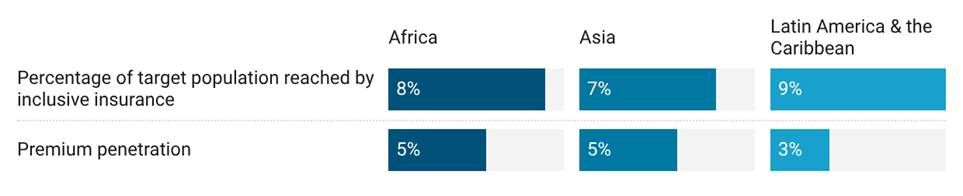
Despite the buoyant numbers and growth in coverage, there is still a noticeable protection gap (Figure 2). Inclusive insurance barely reaches 10% of the target population in Africa, Asia and Latin America. Premium penetration doesn’t exceed 5% in any of these regions. The figures for Asia have typically been higher in previous Landscape datasets. The 2026 figure includes two anomalies: lower reported numbers from India, as well as the inclusion of large countries with low response rates.
Figure 2: Target population reached and premium penetration by region, 2026
Source: Microinsurance Network.
Achieving scale takes time. Data from the 2026 Landscape shows that products aged 5-9 years have a median customer base of over 14,000 (Figure 3). Products under two years old may have fewer than 3,000 customers. These comparisons are important to note. But they represent the gains made by a group of products, rather than illuminate a path for every product to follow.
Figure 3: Median people covered by product age (thousands), 2026

Source: Microinsurance Network.
Getting to scale is not cheap. The median product may spend 25% of its premium on acquisition and administration costs (Figure 4). However, higher costs are not a bad sign. Mobile-enabled microinsurance products can attract a 40% cost but have the highest reach of any channel: over 63,000 people on average. Products with greater coverage tend to spend more: 20% of premium for those covering fewer than 10,000 people, which rises to 37% for those covering 100,000 or more.
Figure 4: Regional comparisons on costs, claims and gender balance (2026)
| Africa | Asia | Latin America and the Caribbean |
Percentage of premium spent on acquisition and administration costs | 20% | 30% | 32% |
Claims ratios | 22% | 26% | 11% |
Percentage of women covered by inclusive insurance | 46% | 64% | 52% |
Source: Microinsurance Network
Cost is an important driver but should be weighed against value. The clearest measure of value is claims paid. Of the 442 products that reported both costs and claims, 55% spend more on acquisition and administration than they pay out to customers. Related to this, two important trends emerged from the 2026 data: products with higher costs tend to have lower claims ratios, while products with higher claims ratios tend to reach greater scale. Neither proves cause and effect, but together they make a strong case that value and growth go hand in hand.
The picture on gender is also incomplete. Women make up 49% of people covered. Microfinance institutions, as well as savings and credit co-operatives, have the highest reach of women: around 60%. Yet only 40% of products reported gender data, fewer than the 2024 Landscape. As a result, gender comparisons are not straightforward to make.
“Inclusive insurance has reached a tipping point. It is no longer a niche topic; it is becoming mainstream.” Matthew Genazzini Executive Director, Microinsurance Network |
What should we be doing?
Over two decades, the inclusive insurance space has relearned the same lessons, while learning new ones as challenges emerge. None of these lessons are new: trust, value, scale and policy have been discussed for years (Figure 5). Most inclusive insurance practitioners could recite these in their sleep. The difference the 2026 Landscape data makes is to add a price tag for not acting on them. Many products barely reach a tenth of their target market, while more than half of products spend more on running themselves than they pay back to customers.
Figure 5: Four familiar lessons, tested against the 2026 data
The lesson | What is working |
|---|---|
Build trust before scale | Not marketing. Government mandates or incentives, bundling with credit and everyday activities, and trusted intermediaries such as agricultural extension officers. |
Treat low claims ratios as a problem to fix | Give value back: Pioneer Insurance raised cover without raising premiums and returned unclaimed value as scholarships. Cut costs with basic digital tools, regional hiring and locally trained claims partners. |
Move beyond pilots | Private-sector-led sustainability; reinsurers offering more than capacity – engaging policymakers and building several markets at once; managing climate risk regionally, not country by country. |
Make insurance part of public policy | Integrating inclusive insurance into national disaster risk financing, and harmonising regulation across Africa with support from the IAIS, AIO and Africa Re. |
Source: Microinsurance Network; ICII 2026 plenary discussions.
From maturity to meaningful protection
The next challenge for inclusive insurance is to turn its budding maturity into greater reach, sustainable scale and tangible value for customers. Currently, the industry’s story is positive yet unfinished. For the story to be complete, each of the four lessons would need to be consistently applied by the sector as a whole.
The 2026 Landscape dataset is now available on the MiN website, and the full report will be published in early 2027.
Special thanks to the
- Landscape sponsors including Luxembourg’s Ministry of Foreign and European Affairs, Defence, Development Cooperation and Foreign Trade, Luxembourg’s Ministry of Finance, AXA, The Global Shield against Climate Risks, Deutsche Gesellschaft für Internationale Zusammenarbeit (GIZ) GmbH, Swiss Re Foundation, Munich Re Foundation, Insurance Federation of Egypt (IFE), the United Nations Development Programme (UNDP), Barents Re.
- Co-organisers of the ICII include the Ministry of Finance and Economic Planning (MINECOFIN), the National Bank of Rwanda (NBR), Access to Finance Rwanda (AFR), Rwanda Insurers Association (ASSAR), and Rwanda Insurance Brokers Association and Munich Re Foundation.